By Gareth Redshaw, Executive Director - Optimization and Strategy @Livingstone
A Microsoft 365 outage may support a commercial discussion, but it doesn't automatically create negotiating leverage or an entitlement to service credits. Credits depend on your agreement and the applicable service-level agreement. Negotiating strength depends on something broader: understanding your dependency, knowing your options, and giving yourself time to act.
Following Friday 13th November’s Microsoft 365 outage, I’ve spoken with organizations of different sizes and across sectors. Almost everyone has asked a version of the same question:
“Can we use this to claim service credits, or as leverage in our negotiation?”
It’s a fair question. But the question I’d ask alongside it is:
“What has this told us about our dependency on Microsoft?”
Can you claim service credits after a Microsoft 365 outage?
Possibly, but the answer lies in your agreement, not simply in the fact that an outage occurred.
You need to understand which services are covered, how downtime is defined, what impact your organization experienced, and what the claims process requires. Those details matter before anyone can give you a meaningful answer.
I would also separate that assessment from the broader renewal discussion. A potential service credit is one contractual issue. Your future commercial relationship with Microsoft is a broader strategic one. They may inform each other, but they are not interchangeable.
If someone offers a simple yes-or-no answer that depends on your agreement, not simply on understanding your position, I’d be cautious.
Does an outage strengthen your negotiating position?
It can give you a reason to challenge service performance and raise commercial concerns. But it can also expose how difficult the platform would be to replace.
For organizations whose inboxes fell quiet, meetings stalled, or Copilot-dependent work was interrupted, the disruption made that dependency tangible. These are not simply products on a licensing schedule. They are embedded in how people work.
Now consider that from the vendor’s side.
If an outage demonstrates how much your organization relies on Microsoft, an implied threat to reduce usage or walk away may become less credible, not more.
That does not mean accepting the commercial position you are offered. It means being honest about the alternatives you could actually pursue.
Dependency cuts both ways. An outage can start a conversation, but it can't replace a credible negotiating position.
What creates real leverage in a Microsoft negotiation?
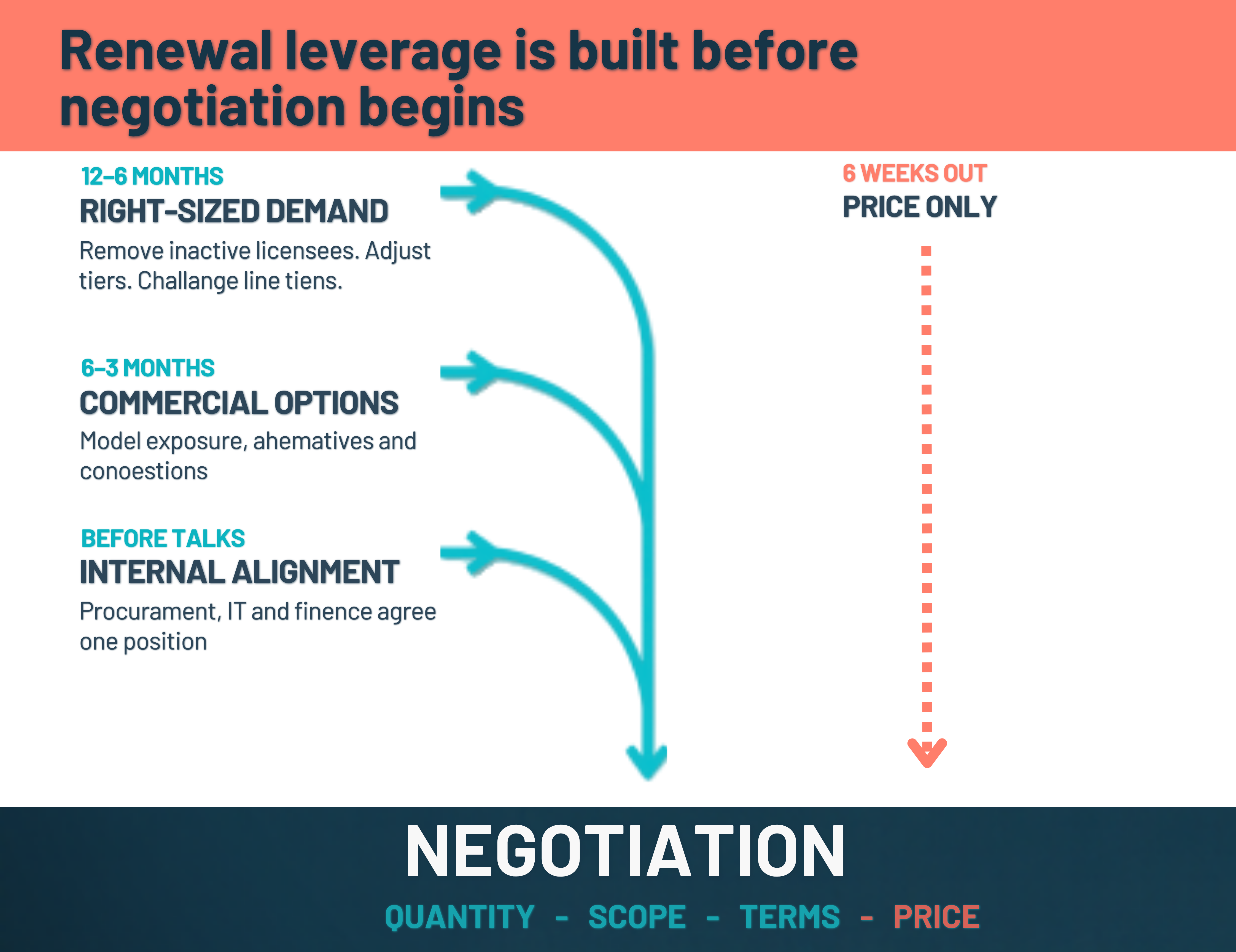
Real leverage comes from understanding your position and having options you can act on.
I would start with four things:
- Evidence: Understand what you use, what you need, and where your dependencies sit.
- Realistic alternatives: Assess what could genuinely change, rather than relying on a theoretical ability to switch.
- Internal alignment: Agree on priorities, acceptable trade-offs, and the outcome your organization wants.
- Time: Leave enough room to test assumptions and make decisions before renewal pressure takes over.
Knowing the value your organization brings to the relationship matters too. The aim is to build a commercial case grounded in your circumstances, rather than expect a single incident to carry the negotiation.
When should you start planning your Microsoft renewal?
For relatively small agreements, I recommend starting at least nine months before renewal. For the largest enterprise environments, with hundreds of thousands of users, I recommend allowing 15–18 months.
These are planning recommendations, not fixed requirements for every organization. The right lead time depends on your environment's complexity and the decisions involved.
That may sound early. But this time lets you understand usage and dependencies, assess alternatives, align stakeholders, and shape the conversation rather than react.
Without it, even a well-founded commercial argument can be difficult to turn into meaningful choices.
What should organizations do after the outage?
Check your contractual position, but use the disruption as a prompt to examine your broader negotiating position too.
The useful lesson is not simply that Microsoft services can be interrupted. It reveals what your organization depends on and the choices you realistically have.
Organizations that negotiate well will take that lesson seriously and prepare early.
If your Microsoft renewal is within the next 18 months, start planning now. Talk to Livingstone to understand your agreement, assess your options, and build an evidence-based renewal strategy.