Every managed service provider pitches the same fantasy: sign this big contract, trust our process, and we'll transform your IT spend. They want your budget upfront, promise capability you don't have yet, and expect you to take a massive leap of faith based on PowerPoint slides.
Here's what actually happens: you're defending that investment every quarter whilst the programme exists in perpetual survival mode. I've watched this pattern destroy programmes across dozens of enterprises.
The problem isn't ambition or methodology. It's the fundamental economics. When you position ITAM or FinOps as a cost centre requiring continuous budget allocation, you're fighting organisational physics that naturally resists ongoing investment in capabilities whose value isn't immediately visible.
What if we've been thinking about this completely backwards?
What if these programmes funded their own evolution through direct, transactable savings? Real money that was flowing out of your organisation and now isn't. Capital that flows back into the programme and funds the next phase without requiring another budget approval cycle. A self-sustaining engine that compounds value rather than consuming resources.
Here's exactly how this works.
The Cost Avoidance Trap (And Why CFOs See Right Through It)
Most ITAM and FinOps programmes lose credibility with finance teams because vendors present cost avoidance as equivalent to actual savings.
"We could have spent this, but now we won't" sounds persuasive until someone in finance asks: was this budgeted spend? Was it contracted? Or was it merely hypothetical expenditure that was never going to materialise? Cost avoidance doesn't free up capital, reduce your budget, or enable reallocation to strategic priorities.
It's not real money.
When I reference self-funding programme architecture, I'm exclusively discussing direct cost savings: hard currency reduction in actual expenditure that was contracted, budgeted, and flowing out of the organisation. Money that can be tracked with precision, measured in hard budget terms, and demonstrably reinvested without requiring new budget approval.
This distinction changes everything: how you structure stakeholder agreements, build measurement frameworks, and establish reinvestment mechanics.
The 20% Reinvestment Model (And Why This Number Works)
The model operates on a simple principle: when we identify and transact genuine cost reduction, 20% flows back into programme infrastructure. That percentage is calibrated to sit below the threshold where finance teams resist reinvestment, but substantial enough to fund meaningful capability expansion.
Finance gets immediate budget relief (80% returned). The programme gets sustained funding (20% reinvested).
The critical step: establish the reinvestment structure before any analysis begins. Define what success looks like with mathematical precision upfront.
Before we examine a single contract, we get budget reality on the table. We ingest actual spend data, run pattern recognition against usage telemetry, and establish projected savings targets based on what the data reveals, not aspirational assumptions. We quantify what's genuinely transactable given contractual constraints and organisational capacity to execute change.
When stakeholders understand the success criteria before work commences, the 20% reinvestment becomes embedded in the original agreement rather than becoming a negotiation point after you've delivered value.
The Real Barrier: Getting Organisations to Show You the Truth
The most significant friction point in any ITAM or FinOps engagement isn't technical complexity. It's getting organisations to reveal their actual spending patterns.
There's institutional embarrassment around waste, uncertainty about asset inventory accuracy, and protective instincts around budget data that might reveal poor historical decisions. People are hesitant to expose the shadow IT purchases, the contracts they don't fully understand, the licence sprawl they know exists, and the vendor relationships where they suspect over-extraction but can't prove it.
We approach it by making their success the primary objective. Not positioning ourselves as heroes who'll rescue them. Not extracting maximum value for our commercial benefit. Making them look brilliant to their CFO, their CIO, and their procurement leadership.
When people genuinely believe you're there to elevate their standing rather than demonstrate your own cleverness, the defensive barriers come down. They share the uncomfortable realities about unmanaged spend, compliance gaps, and vendor relationships where they lack technical literacy to challenge what they're being told.
Contract Archaeology: Why Most "Savings" Can't Actually Be Transacted
Here's a failure pattern that destroys programme credibility: identifying savings opportunities that cannot actually be converted to budget relief.
I've observed competitors present licence position analyses revealing massive over-licensing. The client gets excited. Leadership starts planning how to redeploy that capital. Then contractual reality emerges: they're locked into multi-year enterprise agreements with committed spend that cannot be reduced mid-term.
You've spotted £500,000 in unutilised licences, but you're obligated to continue paying for another 24 months. That's not a savings opportunity you can transact today. That's intelligence for the next renewal negotiation cycle.
This is why we conduct exhaustive contract analysis before making any savings commitments. We examine the contractual terms, licence use rights, exit clauses, and renewal windows. We distinguish between optimisation opportunities that can be executed immediately versus those contractually trapped until specific windows open.
According to the FinOps Foundation, organisations have absorbed tens of millions in audit penalties because they lacked visibility into unused or improperly managed licences. This vetting discipline separates programmes that deliver transactable value from performance theatre that generates impressive reports but zero actual budget relief.
When the Savings Aren't Where You Expected: The AI Advantage
When we discover the savings potential isn't materialising where we initially projected, we don't treat it as programme failure. We pivot to adjacent opportunity areas.
Our AI platform, Acuity; enables us to test multiple hypotheses rapidly. If one area proves less promising under scrutiny, we move to the next candidate. We maintain visible momentum whilst conducting discovery, which preserves stakeholder confidence.
The aggregate data confirms the opportunity space is genuinely massive. Companies waste an average of £18 million annually on unutilised SaaS licences, with large enterprises losing an average of £127 million on licences generating zero productive value. The question isn't whether waste exists in sufficient scale. It's whether you possess the capability to locate it, quantify it with precision, and actually transact it within contractual constraints.
The First Win Changes Everything
The entire programme trajectory hinges on demonstrating capability rapidly in the initial phase. The fastest we've moved from initial data ingestion to validated, presentable results was 72 hours. We identified a 12% cloud cost reduction opportunity, verified the transactability, and presented it to stakeholders whilst the engagement momentum was still fresh.
That rapid initial win validates the analytical approach, builds stakeholder trust through demonstrated competence, and creates psychological momentum that secures buy-in for the longer journey ahead.
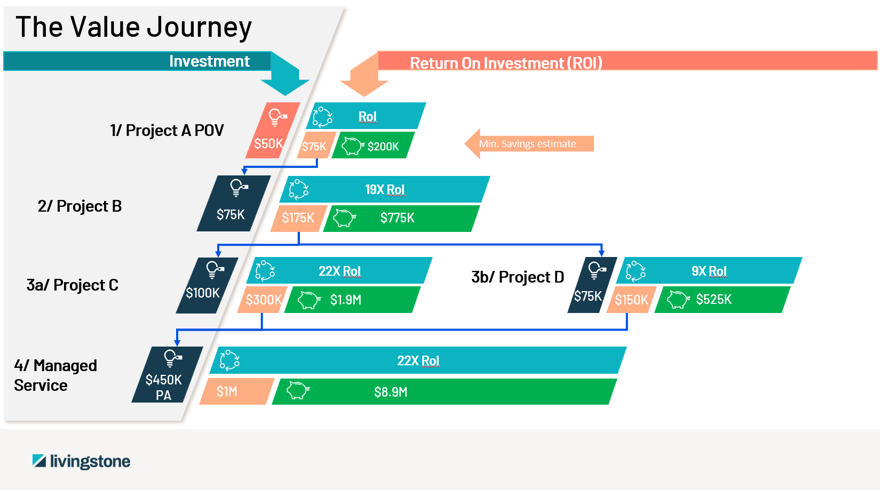
The first win generates capital that funds the second phase. The second phase produces savings that fund the third phase. The third phase builds institutional capability that sustains everything that follows without requiring external budget justification. It's a compounding engine, not a one-time project.
From that initial success, we expand scope progressively: additional spend categories, broader analytical aperture, next priority areas identified during initial discovery. The programme grows organically, funded by its own value generation.
Why Self-Funding Programmes Collapse (And How to Prevent It)
I've watched self-funding programmes lose momentum after the first or second phase despite delivering genuine savings. The failure pattern is consistent: they lack a coherent roadmap beyond the immediate win and haven't secured genuine stakeholder commitment to the multi-phase journey.
Defining what actual success looks like determines whether programmes compound value or fade. Not vague aspirations around maturity improvement. Concrete, measurable outcomes tied to how stakeholders are evaluated by their leadership.
What this means for you: align programme success metrics directly to how individuals are measured in their performance evaluation cycles. The ITAM manager is often evaluated on asset visibility and compliance. Finance leadership is often measured on cost reduction. Procurement is often assessed on contract savings.
If you structure the programme to deliver measurable progress against all three dimensions with monthly, live reporting that each stakeholder can present upwards, everyone perceives the programme as instrumental to their individual success.
When the programme makes people look good to their bosses, it stops requiring defensive justification.
When Priorities Conflict: The Transparency Solution
You'll inevitably encounter situations where stakeholder priorities create tension. Achieving compliance improvements might temporarily increase costs, but procurement leadership is compensated based on quarterly savings delivery.
The resolution mechanism is radical transparency about trade-offs. If everyone is genuinely bought into the long-term journey from the beginning, they demonstrate flexibility when you present clear analysis of sequencing trade-offs and expected payoff timelines. That transparency builds the institutional resilience required for programmes to survive leadership changes and budget pressure.
Why ITAM and FinOps Convergence Creates Multiplicative Value
There's a structural reason we focus on converging ITAM and FinOps disciplines. According to Gartner Projections, by the end of 2026, the majority of enterprises with mature cloud strategies will unify their FinOps and ITAM functions under integrated governance.
ITAM provides visibility into on-premises infrastructure and traditional software licensing. FinOps delivers visibility into cloud consumption patterns and dynamic resource optimisation. Together, they create comprehensive coverage that enables identification of savings opportunities invisible when the disciplines operate in silos.
The self-funding model works precisely because you're not constrained to a single domain. When traditional licence optimisation encounters contractual barriers, you pivot to cloud cost reduction. When cloud savings plateau, you shift to vendor contract renegotiation. The breadth of scope creates programme sustainability that narrow specialisation cannot achieve.
What You're Actually Building (It's Not What You Think)
You're not purchasing cost reduction services. You're building institutional capability.
The self-funding architecture transforms ITAM and FinOps from time-bound projects into capabilities that compound through successive cycles. Each phase builds technical expertise, refines analytical processes, strengthens stakeholder relationships, and expands the scope of what can be effectively governed.
The 20% reinvestment funds organisational learning and capability transfer. It creates the institutional muscle memory required to sustain optimisation discipline long after the initial structured engagement concludes.
Instead of creating perpetual dependency on external expertise, you're systematically building internal capability that becomes genuinely self-sustaining. The programme doesn't require ongoing justification because it demonstrably generates more value than it consumes, visible to finance leadership in hard budget terms.
The organisations that grasp this dynamic don't merely reduce IT expenditure. They build competitive advantage through superior asset stewardship and resource allocation discipline. They free up capital for strategic investment rather than allowing it to leak through operational inefficiency. They reposition their IT teams as strategic value generators rather than cost centres requiring perpetual oversight.
And they accomplish it without requesting incremental budget from finance.
How are you currently funding your ITAM or FinOps capability development?